Repointing, Rebedding or Replacing Ridge Capping?
By Roof Solutions Melbourne ·
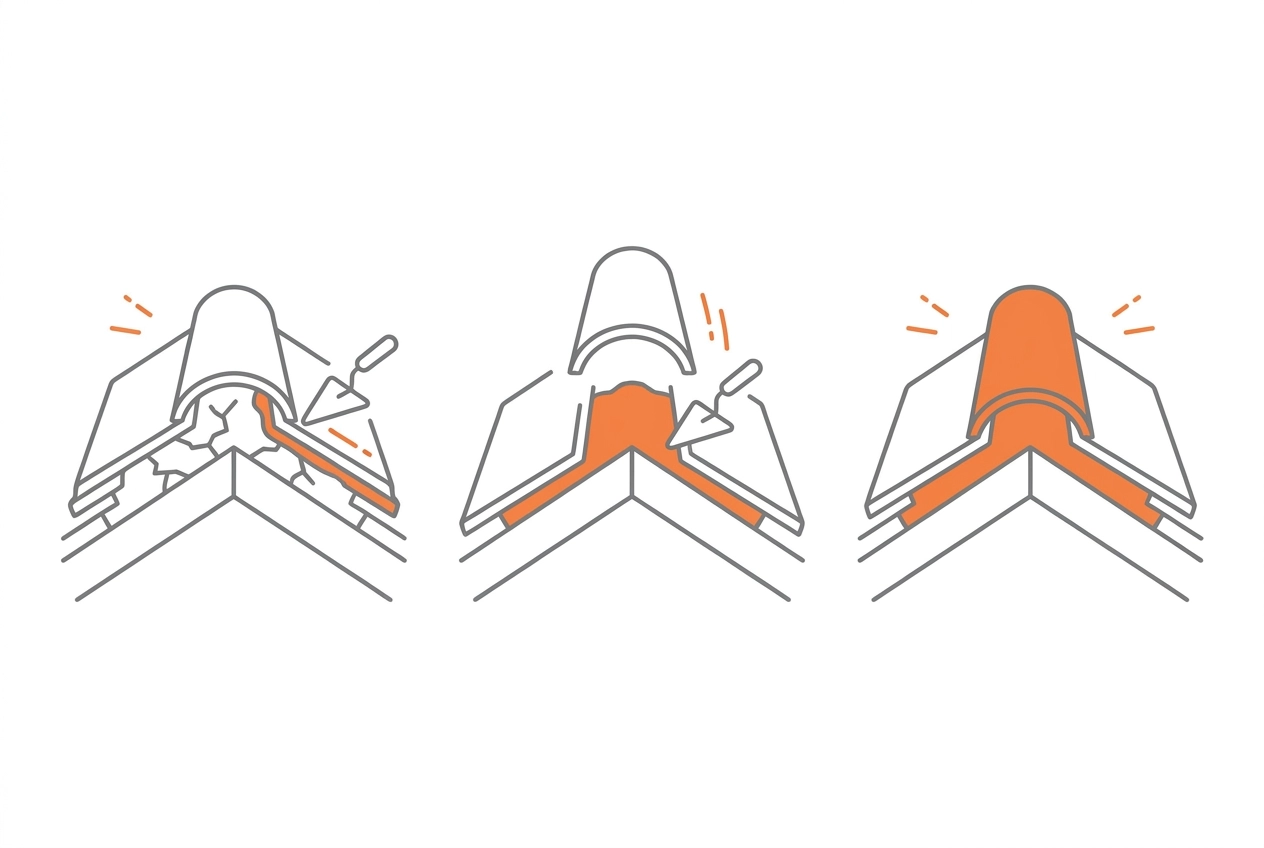
After a Melbourne storm, a cracked or missing line of mortar along the roof ridge is one of the most common reasons water finds its way inside. The repair sounds simple, but homeowners are often quoted for the wrong job: a full rebed-and-replace when a repoint would have sufficed, or a quick repoint over bedding that has already failed. Understanding ridge capping, and the mortar bed beneath it, is the first step to paying only for the work your roof actually needs.
This comparison guide explains what ridge capping and bedding are, then places the three main repairs side by side: repointing when the bed remains sound, rebedding when the bed itself has failed, and full replacement when repair is no longer viable. You will also learn how to assess bedding, why patching over failure rarely lasts, how Melbourne weather and moss affect ridge capping, what shapes cost and quotes, why this is not a DIY task, and what to do next.
What Ridge Capping and Bedding Actually Are
Ridge capping is the row of shaped tiles or concrete caps running along the peak of a tiled roof, covering the gap where two roof planes meet and finishing the ridge line.
Bedding is the mortar bed the capping sits in. It holds the caps firmly in place and fills the void beneath them: a structural role, not a cosmetic one. Australian standards specify bedding mortar at a 4:1 sand to cement ratio, roughly 50 mm wide by 25 mm high (CSIRO).
Pointing is the finished mortar joint along the capping edges. It sheds water off the joint, helps secure the caps and gives the ridge a neat, uniform line.
Put simply: bedding holds the cap up and in place; pointing keeps water out.
Both layers sit above the junction where two roof planes meet, a location that can sometimes make tracing the source of a ceiling leak less straightforward.
The Three Ridge Capping Repairs Side by Side
With the two layers defined, a direct comparison separates the jobs.
Job | What it is | Correct when | What it does not fix |
|---|---|---|---|
Repointing | New mortar to the edge joints only; bedding left undisturbed | Bed firm, caps don't move | Water already tracking through a failed bed |
Rebedding | Old bed removed, caps lifted, new bed laid, caps reset, joints pointed | Bed broken down; caps rock or sit out of line | Perished or cracked caps |
Full replacement | New caps fitted on a fresh bed, then pointed | Caps cracked, spalling or too brittle to re-lay | Little, beyond the tiles below |
The deciding factor is the bedding, not how the pointing looks from the ground. As one trade guide notes, if the ridge tile moves, repointing is not the fix. Ridge work can form part of what roof restoration can include, so ask for the scope to be named plainly.
Repointing Ridge Capping: When the Bed Is Still Sound
Repointing is targeted: rake out loose, crumbling or cracked mortar, clean the joint, then apply new mortar along capping edges. Caps stay in place and the bed beneath remains undisturbed.
It suits firm bedding, caps that do not move when pressed, and a straight, even ridge line. Typical signs: hairline or crumbling edge joints, no cap movement, no sagging, and no history of ceiling leaks tracking to the ridge. It is generally the least disruptive, lowest-cost of the three jobs and usually quickest once access is set up.
It does not stop water already tracking through a failed bed. The fault sits under the layer being repaired, so sealing the joint face does not fix water entering beneath it.
On older Melbourne homes, original mortars may be lime-based rather than cement-based. Heritage guidance notes lime was used in home construction until the mid-20th century, with cement mortars common after World War II, and cautions that mortar compatibility with older fabric is worth checking. Ask your roofer directly about mortar suitability before work starts.
Rebedding Ridge Capping: When the Bed Itself Has Failed
Once the bed has failed, the scope changes. A rebed is the correct call when caps rock, lift or sit out of line, mortar crumbles away in chunks, or the bed has separated from the tiles below it.
The work is deeper than a repoint: the failed bed is removed, the loose caps are lifted, a new bed is laid, and the caps are reset to a straight line before the joints are pointed. Pointing is part of the same visit, so both layers are renewed at once.
It is also the sensible option where earlier patch repairs have left the ridge line uneven, or where small repairs have accumulated over years.
A rebed costs more and takes longer than a repoint, but it targets the cause. Pointing over a failed bed rarely holds, because the caps remain free to move and the new mortar cracks along the same line.
It is worth discussing work timing with your roofer to avoid mortar being disturbed by heavy rain or extreme heat while it sets.
Full Ridge Capping Replacement: When Repair Is Not Enough
When a rebed is not viable, replacement is the honest answer. New caps are typically needed when the originals are in poor condition, visibly cracked, spalling or too brittle to lift without breaking. It also applies where caps have been patched repeatedly, where earlier repairs left mismatched profiles, or where a different ridge profile is being fitted.
The work removes the old caps and bedding, fits new caps on a fresh bed, then points the joints to finish the ridge line. It is the largest and most expensive of the three jobs, but it resets the service life of the whole ridge line rather than buying time on failing materials.
Ask for replacement to be quoted as a separate scope item, not buried inside a general rebed line, so you can see what you are paying for. Not every ridge with bad pointing needs new caps. Sound caps can usually be re-laid on a new bed, keeping the job at rebed level.
How to Tell If Your Bedding Is Still Sound
Before you compare quotes, establish whether the bedding under your caps is still doing its job. All of these checks are safe from the ground.
Watch for caps sitting out of line, gaps between cap and tile below, or mortar grit collecting in the gutter. From the yard with binoculars, or an upper window, look for a sagging or wavy ridge line; rippling suggests the bed underneath has broken down.
Where a cap is safely reachable without walking the roof, press gently. A cap that rocks, lifts or sounds hollow points to a failed bed, not tired pointing. Indoors, staining on ceilings, rafters or battens near the ridge can signal water entering there, especially after wind-driven rain.
A professional inspection covers bed integrity along the full ridge and hips, cap condition, signs of past patching, and the tiles directly below the ridge line. These are among the clearest signs it's time to book a professional inspection.
That is the decision test established in the comparison table above.
Why Patching Over Failed Bedding Does Not Last
If your inspection points to a failed bed, it is worth understanding why a patch over the top will not hold. Sealing the edges of the capping does not restore the bed that holds the caps firm, so a moving ridge line keeps cracking fresh mortar along the same line. Water also tracks under the capping through gaps that external pointing cannot reach, because the entry path sits underneath rather than at the joint face. Smearing new mortar over a failing bed can trap moisture and obscure the true condition of the bedding, making later assessment harder. Patching is not always pointless. Ahead of a planned rebed, or where budget needs staging, it can be a reasonable short-term measure. It is simply no substitute for fixing the bed.
How Melbourne Weather and Moss Affect Ridge Capping
Why patching fails comes down to moisture, and Melbourne supplies plenty of it. Heavy rainfall and gusty winds can drive water sideways into ridge joints, which is often when weakened mortar shows up as a leak.
Moss and lichen can take hold on tiled roofs in wetter months, holding moisture against mortar and tiles rather than letting them dry. Repeated wetting and drying cycles break joints down over years.
Older tiled roofs are more likely to have original bedding that is approaching or past the end of its useful life.
Clogged gutters compound this. Moss, grit and mortar fragments hold moisture at the eaves and can hide where ridge mortar has ended up, so gutter cleaning and periodic inspections are low-cost ways to catch ridge issues before they become leaks. Our roof maintenance FAQs cover how often to check.
Materials and roof profiles behave differently, so the right approach depends on the roof's actual type and condition, not a blanket method.
What Affects the Cost and How to Read a Ridge Capping Quote
Scope and access are the two biggest cost drivers. A repoint along a simple straight ridge is a far smaller job than a full rebed across a complex hip and ridge layout. Height, pitch, storeys, tile fragility and whether fall protection or scaffolding is needed all change labour time. Work above two metres is high-risk construction work under Safe Work Australia guidance, which is one reason access affects pricing. That is why what affects the price varies so much between properties.
Older brittle tiles can break underfoot, so a realistic quote allows for replacing a number of them rather than adding breakages as a surprise extra.
A useful quote itemises raking out, new bedding, new pointing, how many caps will be replaced, and whether gutters are cleared after the job. Ask plainly whether it is a repoint, rebed or replacement, and whether hips, ridge ends and other junctions are included, not just the main ridge.
Comparing quotes with different scopes is how homeowners overpay or under-fix. Line up at least two written quotes with matching scope before deciding.
Working at Heights: Why This Is Not a DIY Job
Whichever job the quotes point to, the work itself happens at height. The ridge sits at the highest, most exposed point of the roof, typically on a pitch where a fall would be serious. Tiled surfaces can be hazardous underfoot, particularly when wet or affected by moss and lichen. Falls from height remain one of the most serious risks in construction and home maintenance, and licensed roofers working on residential roofs are subject to Victoria's work-at-height obligations.
Don't walk a tiled roof to inspect or patch ridge mortar. Stay on the ground with binoculars, or photograph the ridge from an upper window or by drone. DIY ridge work is no safer than trying roof cleaning from a ladder, which carries the same risks. A professional inspection with proper access equipment is safer and more accurate along the ridge line.
Frequently Asked Questions About Ridge Capping
What does repointing involve, and how long does it take? Raking out loose mortar along the capping edges and applying new mortar, caps left in place. Duration varies with ridge length and access; ask your roofer for a time estimate when booking.
Repoint or rebed? If a cap rocks or the ridge line sags, the bed has failed and rebedding is the honest answer. Roofers read much from the ground; inspection confirms it.
Why do quotes differ? Ridge length, pitch, height, access, tile fragility and raking-out labour. They compare only when both name repoint, rebed or replace.
How long should bedding and pointing last? No fixed figure applies. Wind-driven rain, moss holding moisture and repeated patching shorten lifespan. Method depends on roof material and condition: How Roof Solutions Melbourne Chooses a Cleaning Method.
Can a repoint fix a ceiling leak? Only if water enters at the joint face. Leaks also track from flashings, valleys and underlay.
What to Do Next
If the answers above leave you with one question, make it this: is the bedding under your caps still sound? That verdict decides the scope, as set out in the comparison above.
The warning signs described above all justify an inspection rather than a guess. Before comparing prices, ask each quote to state plainly whether it is a repoint, rebed or replace, so you compare like with like.
If your ridge line has not been checked in several years, book a roof inspection ahead of storm season. Roof Solutions Melbourne covers ridge capping repointing, rebedding, tile repairs, gutter cleaning and roof inspections across Melbourne and surrounding suburbs, including local roof restoration in Moorabbin.
Conclusion
The right repair comes down to whether the bedding is still sound, repoint for tired joints, rebed for a failed bed, replace for perished caps. If your ridge line hasn't been checked recently, book a roof inspection ahead of storm season.